Picture

Northwestern Medicine
​Breakthroughs for Physicians

​​
  • Home
  • Specialties
    • Cardiovascular >
      • Research
      • Clinical Breakthroughs
      • News
    • Endocrinology >
      • Clinical Breakthroughs In Endocrinology
      • Research In Endocrinology
      • News
    • ENT (Otolaryngology) >
      • Clinical Breakthroughs
      • Research
      • News
    • Gastroenterology >
      • Clinical Breakthroughs
      • Research
      • News
    • Geriatrics >
      • Clinical Breakthroughs
      • Research
      • News
    • Neurosciences >
      • Rare and Complex Brain Tumors
      • Research
      • COVID-19 and Neurosciences
      • News
      • Clinical Breakthroughs
    • OB-GYN >
      • Clinical Breakthroughs
      • Research
      • News
    • Oncology >
      • Clinical Breakthroughs
      • Research
      • News
    • Ophthalmology >
      • Clinical Breakthroughs
      • Research
      • News
    • Organ Transplant >
      • Clinical Breakthroughs
      • Research
      • News
    • Orthopaedics >
      • Clinical Breakthroughs
      • Research
      • News
    • Psychiatry >
      • Clinical Breakthroughs
      • Research
      • News
    • Pulmonary >
      • Clinical Breakthroughs
      • Research
      • News
    • Rehabilitation >
      • Clinical Breakthroughs
      • News
    • Rheumatology >
      • Clinical Breakthroughs
      • Research
      • News
    • Urology >
      • Clinical Breakthroughs
      • Research
      • News
  • CME
  • REFERRALS
    • Refer to NM Cardiovascular
    • Refer to NM Neurosciences
    • Refer to Other Specialties

< BACK TO RESEARCH IN ONCOLOGY

January 2024

UROLOGY

AS PATIENTS LIVE LONGER, NEW CRITERIA NEEDED FOR PROSTATE CANCER TRIALS

Featuring: Maha Hussain, MD

​A lack of cancer progression could be used as a substitute for overall survival in metastatic hormone-sensitive prostate cancer clinical trials, according to a new meta-analysis published in the Journal of Clinical Oncology, an approach that could accelerate research and allow new treatments to reach patients faster.

Out of every 100 American men, roughly 13 will get prostate cancer during their lifetime, according to the Centers for Disease Control and Prevention, and about two to three of those will die from the cancer.

While there is no cure, prostate cancer can be slowed by lifelong hormone therapy, which works by suppressing the production of testosterone.

​Because of recent advances in treating prostate cancer, patients survive longer than ever before, said Maha Hussain, MD, the Genevieve E. Teuton Professor of Medicine in the Division of Hematology and Oncology and a co-author of the new study. This means that clinical trials measuring how long patients live after an experimental treatment can take decades, slowing overall research progress.

“In the older days, when we didn’t have the strong treatments we have now — men with metastatic hormone-sensitive prostate cancer survived on average for two and a half to three years,” said Hussain, who is also deputy director of the Robert H. Lurie Comprehensive Cancer Center of Northwestern University. “Now, on average they survive about six years and some may survive for a decade with treatment. So, to do a clinical trial and wait for the overall survival on average, you’re really waiting a decade plus to get the outcomes.”

In the current study, Hussain and her collaborators sought to understand if a lack of cancer progression as monitored by radiography could substitute overall survival as a metric for metastatic prostate cancer clinical trials.

​Investigators analyzed data from more than 6,300 patients involved in nine previous prostate cancer hormonal therapy clinical trials in the last three decades and found that radiographic progression-free survival and clinical progression-free survival were comparable stand-ins for overall survival, according to the study.

“Essentially, the bottom line is: both radiographic progression-free survival and progression-free survival can potentially be used as an endpoint because they are strong surrogates for overall survival,” Hussain said.

Moving forward, Hussain said she hopes the new criteria will accelerate clinical trials conducted for metastatic prostate cancer and allow new treatments to reach patients who need them faster.

“We’ve come a long way with prostate cancer,” Hussain said. “I’m hopeful that with new, powerful agents, we will have a cure at some point. At least for now, patients are living much longer.”

The study was supported in part by the Prostate Cancer Foundation Challenge Award, Prostate Cancer UK Grant RIA 16-ST2-020, National Institutes of Health grants R01 CA256157 and R01 CA249279, the UK Research and Innovation Medical Research Council grant MC_UU_00004/06, and the United States Army Medical Research Award HT9425-23-1-0393.

​This article was originally published in the Northwestern University Feinberg School of Medicine News Center on January 25, 2022. 
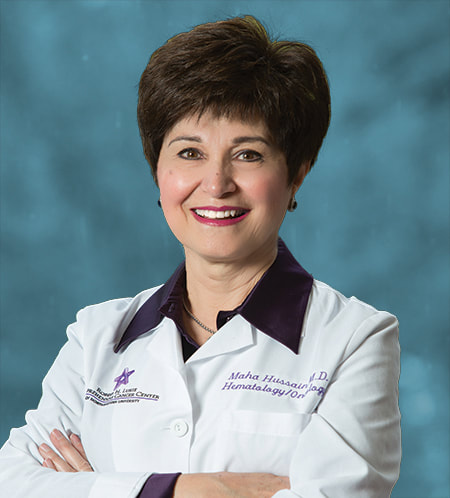
Maha Hussain, MD headshot
Maha Hussain, MD,  the Genevieve E. Teuton Professor of Medicine in the Division of Hematology and Oncology, was a co-author of the new study published in the Journal of Clinical Oncology.

Refer a Patient

Northwestern Medicine welcomes the opportunity to partner with you in caring for your patients. ​
Call 312.695.8146
Find an NM Oncologist

You May Also Like

Dr Krambeck in OR

December 2022

ONCOLOGY
Bin Zhang, MD, PHD, Named Co-leader Of Tumor Environment And Metastasis Program
Dr Meeks with patient

September 2022

ONCOLOGY
NIH Initiative To Systematically Investigate And Establish Function Of Every Human Gene
Physicians looking at a computer screen

October 2022

ONCOLOGY
Newly Identified Protein Drives Breast Cancer Stemness And Metastasis

Northwestern Medicine Breakthroughs for Physicians

About Us     Terms of Use     Privacy Policy     How to Vote for U.S. News & World Report Best Hospitals
© 2026 Northwestern Medicine® and Northwestern Memorial HealthCare. 
Northwestern Medicine® is a trademark of Northwestern Memorial HealthCare, used by Northwestern University
Connect with us
[email protected]
International physicians, contact [email protected]
  • Home
  • Specialties
    • Cardiovascular >
      • Research
      • Clinical Breakthroughs
      • News
    • Endocrinology >
      • Clinical Breakthroughs In Endocrinology
      • Research In Endocrinology
      • News
    • ENT (Otolaryngology) >
      • Clinical Breakthroughs
      • Research
      • News
    • Gastroenterology >
      • Clinical Breakthroughs
      • Research
      • News
    • Geriatrics >
      • Clinical Breakthroughs
      • Research
      • News
    • Neurosciences >
      • Rare and Complex Brain Tumors
      • Research
      • COVID-19 and Neurosciences
      • News
      • Clinical Breakthroughs
    • OB-GYN >
      • Clinical Breakthroughs
      • Research
      • News
    • Oncology >
      • Clinical Breakthroughs
      • Research
      • News
    • Ophthalmology >
      • Clinical Breakthroughs
      • Research
      • News
    • Organ Transplant >
      • Clinical Breakthroughs
      • Research
      • News
    • Orthopaedics >
      • Clinical Breakthroughs
      • Research
      • News
    • Psychiatry >
      • Clinical Breakthroughs
      • Research
      • News
    • Pulmonary >
      • Clinical Breakthroughs
      • Research
      • News
    • Rehabilitation >
      • Clinical Breakthroughs
      • News
    • Rheumatology >
      • Clinical Breakthroughs
      • Research
      • News
    • Urology >
      • Clinical Breakthroughs
      • Research
      • News
  • CME
  • REFERRALS
    • Refer to NM Cardiovascular
    • Refer to NM Neurosciences
    • Refer to Other Specialties